
‘munch’ crunches markdown text and ‘flextable’ paragraphs into grid graphics.
‘munch’ started as internal code in ‘flextable’ for rendering rich text with ‘grid’. It was extracted into its own package to also serve ‘ggiraph’ and to provide unified formatting between ‘ggplot2’ graphics and ‘flextable’ tables.
‘munch’ lets you produce this annotated graphic:

The title, subtitle, caption and axis labels above are all built with
element_chunks() and ‘flextable’ paragraph objects, bold,
italic, colors, highlights, superscripts, subscripts, strikethrough and
an embedded image.
| Function | Purpose | Input |
|---|---|---|
element_md() |
Markdown in theme elements | Character string |
element_chunks() |
Advanced formatting in theme elements | as_paragraph() object |
geom_text_md() |
Markdown text annotations | label aesthetic |
geom_label_md() |
Markdown labels with background | label aesthetic |
# install.packages("pak")
pak::pak("ardata-fr/munch")‘munch’ requires graphics devices that support ‘systemfonts’: ‘ragg’, ‘svglite’, or ‘ggiraph’. ‘cairo’
devices is also supported when fonts are installed at the system level.
See vignette("font-recipes") for font configuration,
alternative devices, and troubleshooting.
Use element_md() for markdown in theme elements, and
geom_text_md() or geom_label_md() for
annotations:
library(ggplot2)

ggplot(mtcars, aes(mpg, wt)) +
 geom_point() +
 labs(title = "**Fuel consumption** vs *Weight*") +
 theme(plot.title = element_md(size = 16))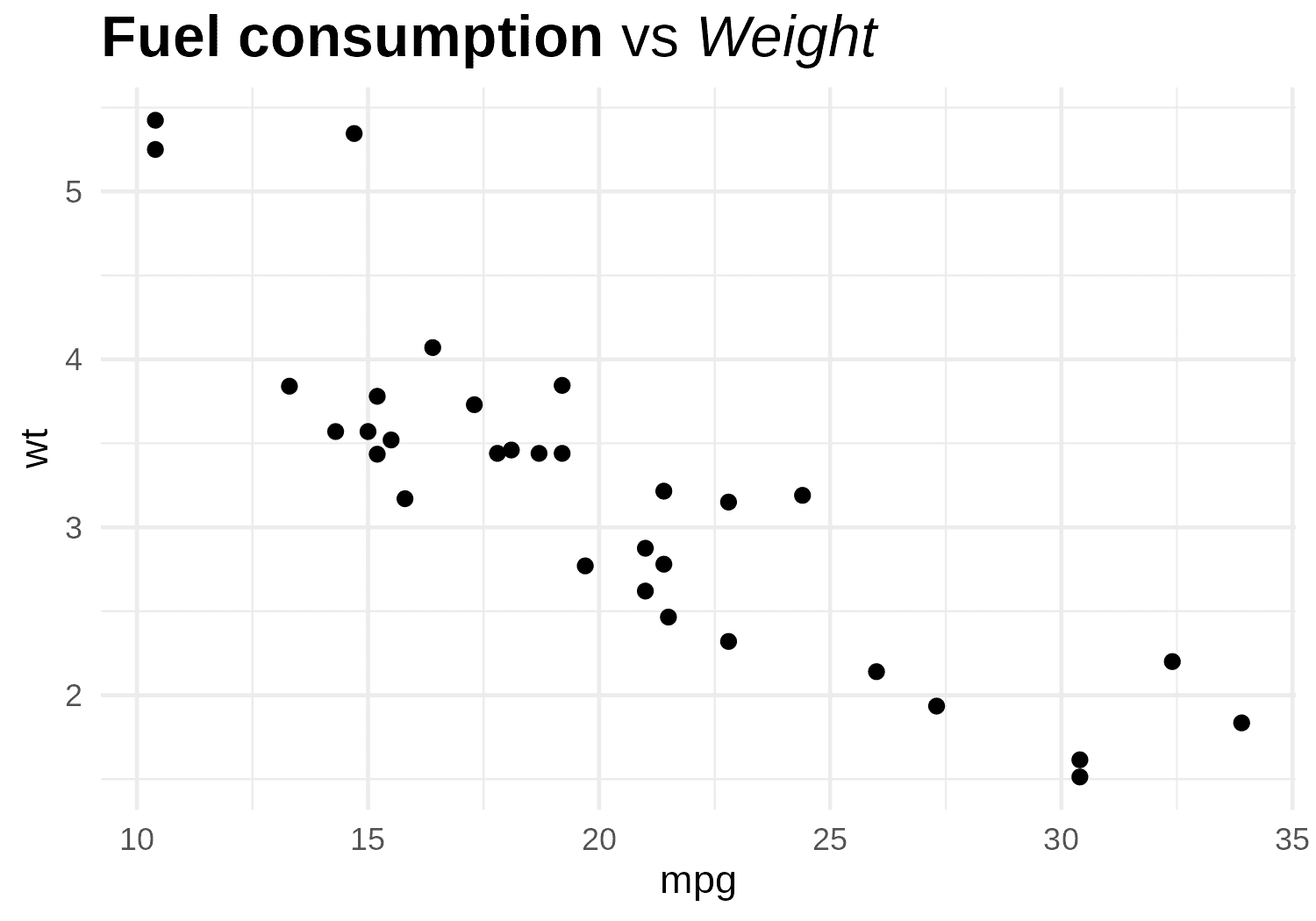
For advanced formatting (superscripts, subscripts, colors), use
element_chunks() with ‘flextable’ paragraph objects:
title_chunks <- as_paragraph(
 as_chunk("Model: R"), as_sup("2"), as_chunk(" = 0.75")
)

ggplot(mtcars, aes(mpg, wt)) +
 geom_point() +
 theme(plot.title = element_chunks(title_chunks))
| Syntax | element_md() |
element_chunks() |
|---|---|---|
| Bold / Italic | **text** / *text* |
as_b() / as_i() |
| Inline code | `code` |
x |
| Strikethrough | ~~text~~ |
as_strike() |
| Superscript | x | as_sup() |
| Subscript | x | as_sub() |
| Custom colors | x | colorize() |
| Highlighting | x | as_highlight() |
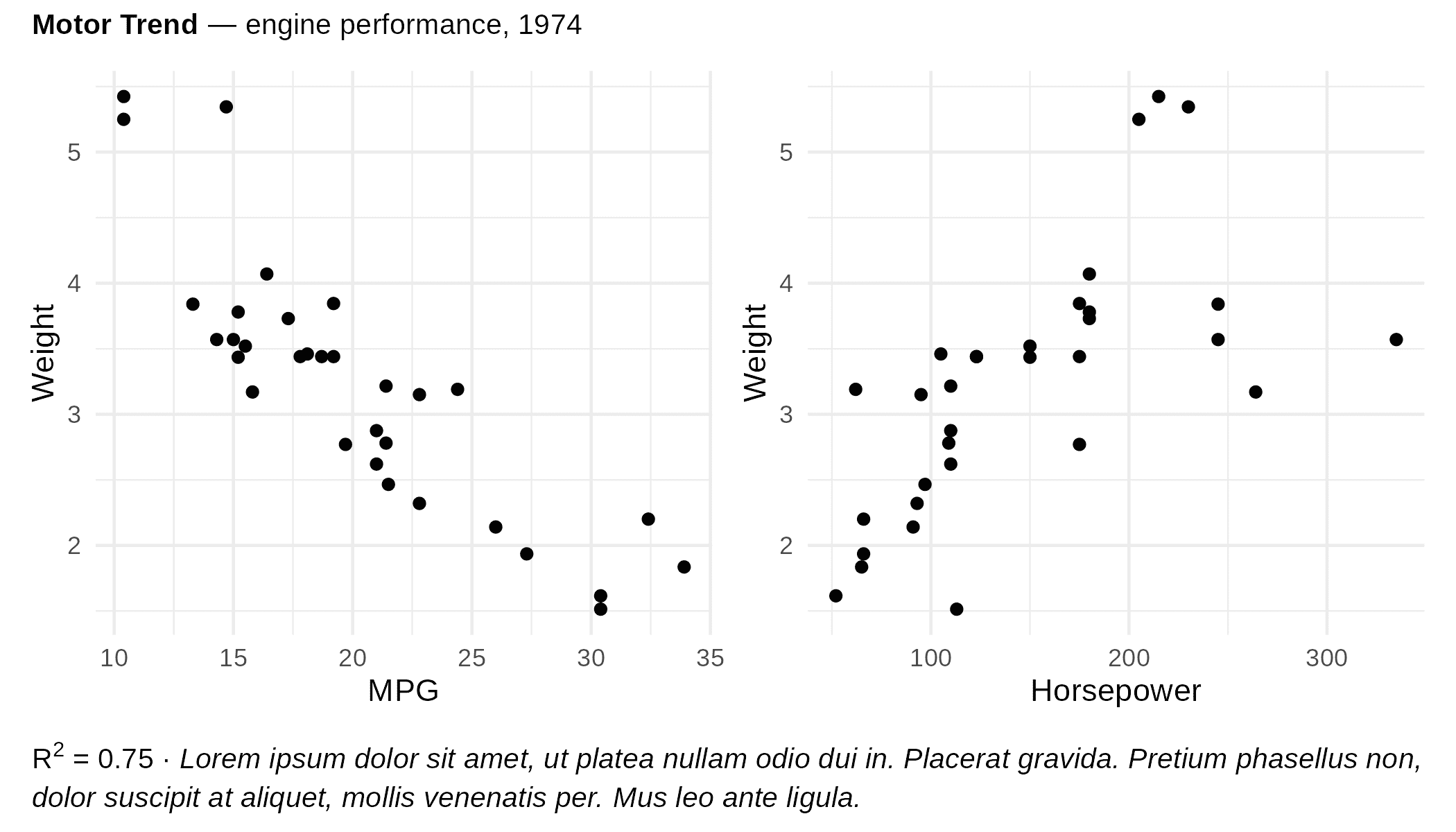
Use munch_annotation() as a drop in replacement for
patchwork::plot_annotation() which accepts
element_chunk() and element_md() to add
rich-text titles, subtitles, and captions — including auto-wrapping — to
combined plots:
library(ggplot2)
library(patchwork)

p1 <- ggplot(mtcars, aes(mpg, wt)) +
  geom_point() +
  labs(x = "MPG", y = "Weight")

p2 <- ggplot(mtcars, aes(hp, wt)) +
  geom_point() +
  labs(x = "Horsepower", y = "Weight")

title_chunks <- as_paragraph(
  as_b("Motor Trend"), as_chunk(" — engine performance, 1974")
)

caption_chunks <- as_paragraph(
  as_chunk("R"), as_sup("2"), as_chunk(" = 0.75 · "),
  as_i("Lorem ipsum dolor sit amet, ut platea nullam odio dui in. "),
  as_i("Placerat gravida. Pretium phasellus non, dolor suscipit at aliquet, "),
  as_i("mollis venenatis per. Mus leo ante ligula.")
)

wrap_plots(p1, p2) +
  munch_annotation(
    title   = element_chunks(title_chunks),
    caption = element_chunks(caption_chunks, lineheight = 1.5, hjust = 0)
  )
For plain markdown text, pass the content as a string and use
element_md() in the theme argument — the same
pattern as regular ggplot2 theming:
wrap_plots(p1, p2) +
  munch_annotation(
    title   = "**Motor Trend** — engine performance, 1974",
    caption = "R^2^ = 0.75 · *Lorem ipsum dolor sit amet, ut platea nullam odio dui in. Placerat gravida pretium phasellus non, dolor suscipit at aliquet.*",
    theme   = theme(
      plot.title   = element_md(),
      plot.caption = element_md(lineheight = 1.5, hjust = 0)
    )
  )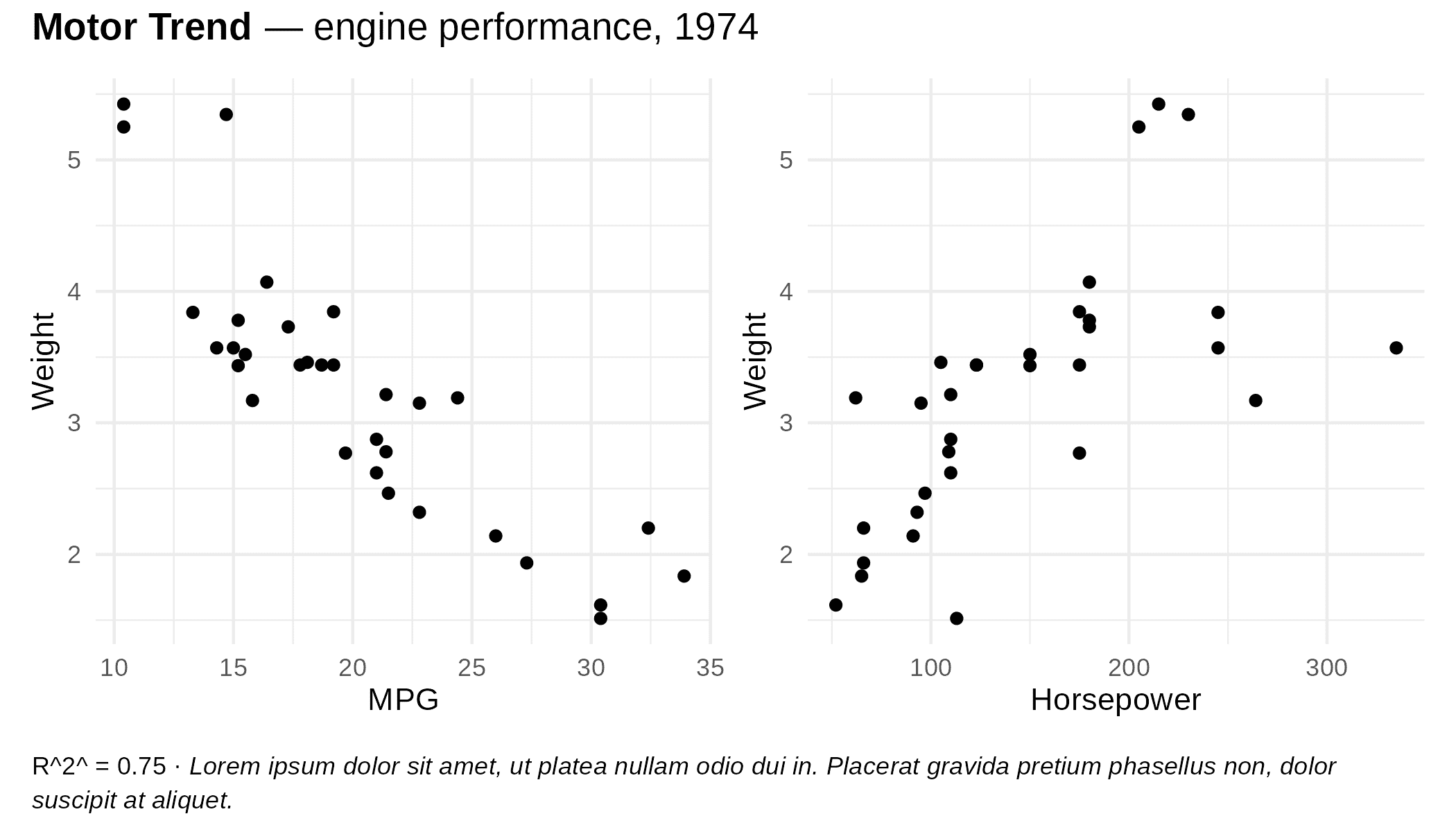
The caption auto-wraps to the full figure width at render time, so it
works correctly regardless of output size. title,
subtitle, and caption each accept an
element_chunks() or element_md() object, a
bare as_paragraph() object, or a plain character
string.
Use as_paragraph_md() for markdown in table cells:
ft <- flextable(head(iris, 3))
ft <- mk_par(ft, j = 1, part = "header",
 value = as_paragraph_md("*Sepal* **Length**"))
autofit(ft)
library(munch)
library(grid)

gr <- md_grob("This is **bold** and *italic* text.")
grid.newpage()
grid.draw(gr)
For superscripts, subscripts, or colors not available in markdown,
use ‘flextable’ chunks with chunks_grob():
library(flextable)

chunks <- as_paragraph(as_chunk("E = mc"), as_sup("2"))
gr <- chunks_grob(chunks)
grid.newpage()
grid.draw(gr)
element_md(),
element_chunks(), geom_text_md(),
geom_label_md()md_grob(), chunks_grob(), text
properties, images‘gridtext’ by Claus O. Wilke (used by ‘ggtext’) renders formatted text via a subset of HTML/CSS. ‘munch’ takes a different approach: it uses markdown or ‘flextable’ chunks as input and relies on ‘systemfonts’ for text measurement.
| munch | gridtext | |
|---|---|---|
| Input format | Markdown, flextable chunks | HTML / CSS subset |
| Superscript / subscript | Yes (as_sup(), as_sub()) |
Yes (<sup>, <sub>) |
| Custom colors / highlight | Yes (via colorize(), as_highlight()) |
Yes (via inline CSS) |
| Inline images | Yes | Yes |
| Text wrapping | Yes | Yes (textbox_grob()) |
| Text measurement | TBD | TBD |
| Integration with ‘flextable’ | Yes (shared chunk model) | No |
| Supported devices | ‘ragg’, ‘svglite’, ‘ggiraph’, cairo | Most R graphic devices |
| Compiled code | No (pure R) | Yes (C++ via ‘Rcpp’) |
‘marquee’ by Thomas Lin Pedersen offers more markdown features (headings, lists, code blocks, custom spans). ‘munch’ focuses first on integration with ‘flextable’ chunks and advanced formatting not available in markdown.
cairo_pdf(), png(type = "cairo"), eventually
pdf() with few cautions.